


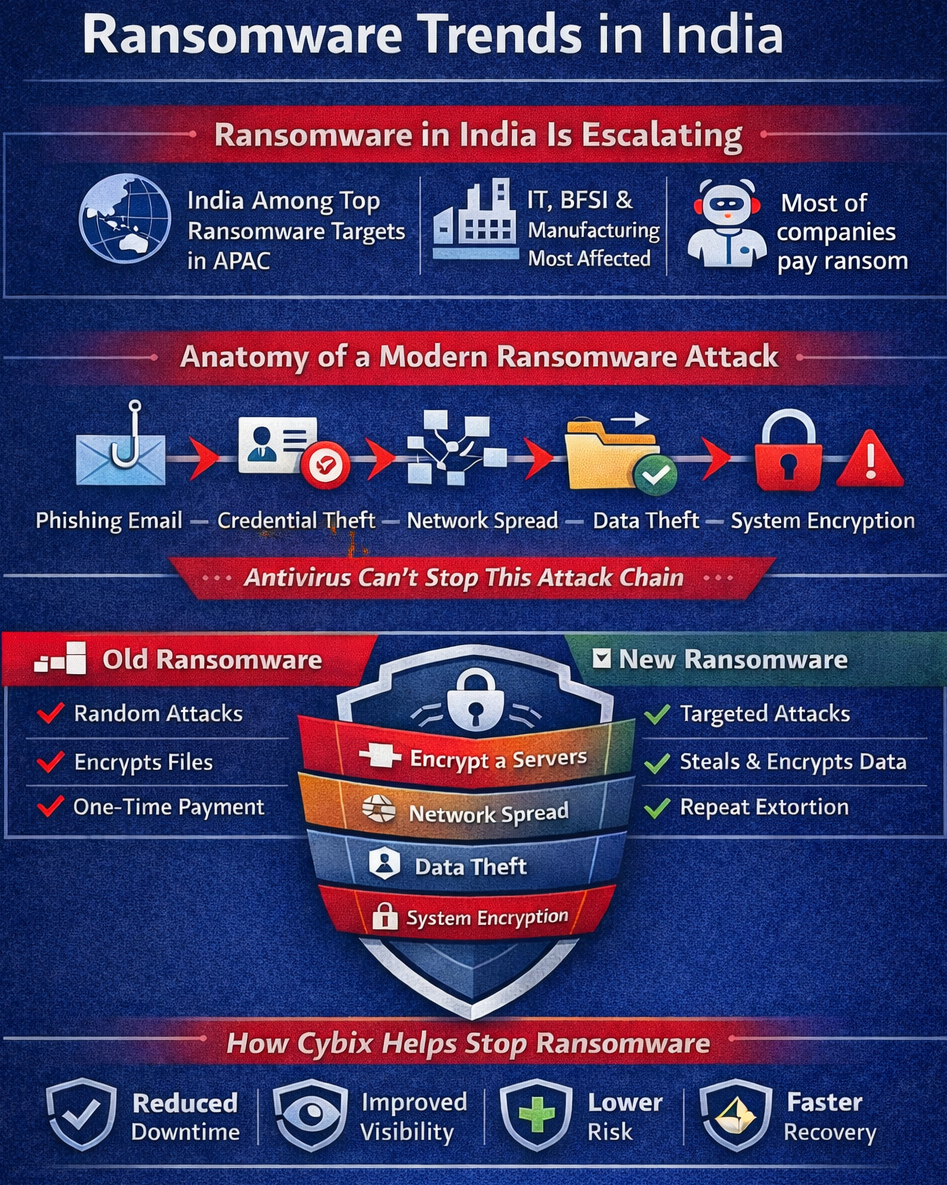
India is no longer just a growing digital economy — it has also become one of the most attractive targets for ransomware attackers. With rapid cloud adoption, hybrid work environments, and legacy infrastructure still in use, Indian organizations are facing a new, more dangerous wave of ransomware attacks.
In this blog, we break down the latest ransomware trends in India and what enterprises must do to stay resilient in 2026 and beyond.
- India Has Become a Prime Ransomware Target
Ransomware groups are increasingly focusing on Indian organizations due to:
- Rapid digitization across sectors
- Large volumes of sensitive business and customer data
- Gaps in cybersecurity maturity, especially in mid-size enterprises
Industries such as IT services, BFSI, manufacturing, healthcare, and logistics are seeing a sharp rise in attacks. Attackers know that downtime in these sectors directly impacts revenue, making ransom demands more likely to be paid.
Reality check: Ransomware attacks are no longer random — they are planned, targeted, and financially motivated.
- AI-Driven Ransomware Is Changing the Game
One of the most concerning trends is the use of Artificial Intelligence by ransomware groups.
Attackers are now using AI to:
- Automatically scan networks for weak points
- Craft highly convincing phishing emails and fake alerts
- Impersonate executives, vendors, and cloud service providers
- Identify high-value systems for maximum disruption
This makes traditional, signature-based antivirus tools ineffective. Attacks today are faster, smarter, and harder to detect.
- Rise of Ransomware-as-a-Service (RaaS)
Ransomware is no longer limited to elite hacker groups. With Ransomware-as-a-Service (RaaS):
- Cybercriminals rent ransomware kits
- Affiliates launch attacks with minimal technical knowledge
- Attack volume increases exponentially
This has led to more frequent and widespread attacks, especially against small and mid-size businesses that lack advanced defenses.
- Double & Triple Extortion Is Now the Norm
Modern ransomware attacks go far beyond encrypting files.
Attackers now:
- Steal sensitive data
- Encrypt systems
- Threaten public data leaks or regulatory exposure
This “double” or “triple extortion” approach puts immense pressure on organizations — even those with backups — forcing them to consider paying ransom to avoid reputational and legal damage.
- Legacy Infrastructure Is a Major Entry Point
A significant number of ransomware attacks in India exploit:
- End-of-Life (EOSL) firewalls and servers
- Unpatched operating systems
- Poorly configured VPNs and remote access tools
- Lack of visibility across IT assets and AMC coverage
Legacy infrastructure creates blind spots that attackers actively search for.
- High Ransom Payments, Low Recovery Success
Many Indian organizations still believe that paying ransom equals recovery — but this is a dangerous myth.
- Ransom payments do not guarantee full data recovery
- Stolen data may still be sold or leaked
- Repeat attacks are common once an organization is marked as “willing to pay”
Prevention and preparedness are far more cost-effective than recovery.
- What Businesses Must Do Now
To defend against modern ransomware threats, organizations must shift from reactive security to proactive cyber resilience.
Key focus areas:
- Continuous monitoring & threat detection
- Network and endpoint visibility
- Zero Trust security principles
- Regular patching and lifecycle management
- Secure backups and disaster recovery planning
- Employee awareness against phishing and social engineering
How Cybix Helps Organizations Stay Ransomware-Ready
At Cybix, we help businesses reduce ransomware risk through:
- 🔐 Advanced firewall & network security (Fortinet, Palo Alto Networks)
- 🖧 Infrastructure health checks & EOSL risk assessments
- 📊 IT asset & AMC visibility
- 👨💻 Proactive monitoring and managed security services
- 🛡️ Security architecture aligned to modern threat landscapes
Our approach focuses on prevention, visibility, and rapid response, helping organizations stay operational even under attack.
Ransomware in India is evolving — and fast. Organizations that rely on outdated security models are no longer just vulnerable; they are targets.